
“Everything’s come back normal.”
If your GP's said that while you're still exhausted, foggy, bloated or just off, here's the short answer: normal doesn't mean optimal. Standard blood test reference ranges are wide statistical bands designed to catch disease, not to tell you whether you feel well. You can sit right at the edge of "normal" and still feel dreadful, because the range was never measuring that.
You're not imagining it. And "normal" isn't the full story.
I hear this more than almost anything else from clients I work with. You’ve done the responsible thing: booked the GP appointment, had the bloods done, waited for the results, and then been told there's nothing there. Everything is "normal," and an unspoken suggestion that maybe this is just what your late thirties, forties or fifties feels like now.
It isn't. Here's what's actually going on.
What "normal" actually means on a blood test
So a standard lab reference range isn't a measure of optimal health. It's a statistical range built from a large cross-section of the population, some healthy, some not, marking out where roughly 95% of people fall. Land inside that band and you're flagged "normal," even if you're sitting right at the outer edge with a very different result to the one you'd get if you were feeling well.
That's not a flaw in your GP's approach. It's what those ranges are for. GPs work within the NHS to rule out disease efficiently: is this thyroid failing, is this person dangerously anaemic, does this need urgent treatment. That's a different question to the one I'm usually asking, which is closer to: what does this person's body need to feel genuinely well? not just clear of diagnosable disease.
Nutritional therapists tend to work with narrower, functional ranges instead, informed by where markers sit in people who report feeling energised, clear-headed and well, rather than simply "not currently unwell." Two people can have the same "normal" ferritin level, thyroid result or B12 reading and feel completely different day to day. One's at the strong, functional end of the range. The other's scraping along the bottom, technically inside the lines but nowhere near thriving.
A few examples I see often:
Ferritin (your iron stores) can sit at the very bottom of the "normal" range and still be linked with fatigue, hair thinning, poor concentration and breathlessness, long before it's low enough to count as iron-deficiency anaemia. A meta-analysis in the British Journal of Nutrition (1) backs this up: iron deficiency without anaemia is a genuine, measurable cause of fatigue.
TSH (a key thyroid marker) has a notably wide lab range, and where exactly the upper cut-off should sit is still debated among endocrinologists, with some proposing it should be lower than the standard used today (2). Plenty of people sitting at the upper end of "normal" still report classic underactive-thyroid symptoms: low energy, weight gain that won't budge, cold hands and feet, low mood.
Vitamin B12 can be "in range" while still too low to support the energy and nervous system function you actually need. Borderline serum B12 results are a recognised grey area (3): clinical guidance notes that further markers, like methylmalonic acid, are often needed to rule out a functional deficiency that the headline number alone would miss.
Vitamin D can come back as "sufficient" while sitting only just above the cut-off used to flag deficiency. In the UK, NHS guidance sets that cut-off at 50 nmol/L (4), and it's specifically framed as sufficient for bone health, not necessarily for energy, mood or immune function. A result of 55 nmol/L is technically "normal," even though it's a long way from the levels associated with feeling genuinely well. Low-normal vitamin D is commonly linked with fatigue, low mood, muscle aches and a weaker immune response, especially through the darker months.
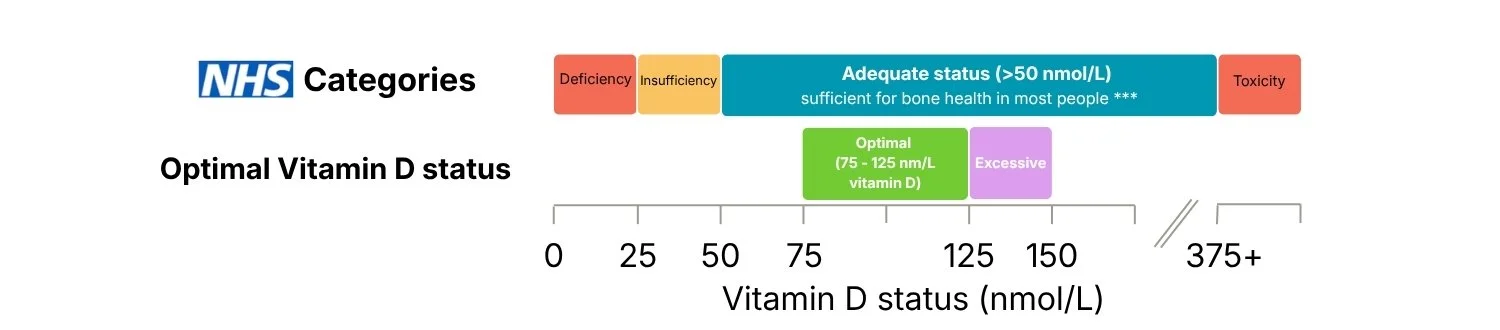
NHS versus Optimal vitamin D status
Why this isn't your GP getting it wrong
I want to be clear about this, because "normal doesn't mean fine" can sound like GP-bashing. It isn't. Your GP has minutes, not hours, and a system built to catch disease and prioritise the most unwell patients first. That's exactly what it should do.
What it isn't built to do is sit with your whole picture, your stress levels, sleep, cycle, digestion, history, and ask why you feel the way you do when nothing's technically broken yet.
That's the gap I work in. Think of it as investigation rather than a second opinion: not re-running the same test and hoping for a different answer, but asking a wider set of questions, looking at markers together instead of in isolation, and tracking patterns over time instead of a single snapshot.
Three signs your bloodwork needs a second look
Not every "normal" result needs digging into. But take it seriously if:
You've had the same explanation more than once. "It's probably just stress," "it's probably just your age," "it's probably just how you're wired," said more than once with nothing changing, isn't an explanation. It's a shrug.
Your results are normal, but you're not. Fatigue that sleep doesn't fix, bloating with no obvious pattern, a cycle that's changed, brain fog that's affecting your work, and the paperwork says fine. That mismatch is worth investigating, not dismissing.
You're already doing "all the right things." Eating reasonably, moving your body, trying to sleep, and still not feeling like yourself. That's usually a sign there's something underneath that generic advice won't touch, not a sign you need to try harder at the basics.
What to actually do next
If you recognise yourself in any of this, you don't need to overhaul your life tonight. A few practical steps:
Ask for your actual numbers, not just "normal" or "abnormal." You're entitled to the figures, not just the flag. Most GP surgeries will give you these through your online patient portal or on request.
Ask what was tested, specifically. "Thyroid function" often means TSH alone. Ask whether free T4 and free T3 were included, and whether ferritin, B12 and vitamin D were part of the panel, not assumed.
Write down your symptoms with some detail, not just "tired." When did it start, what makes it worse, does it follow a pattern with your cycle or your week. Vague symptoms get vague answers. Specific ones get taken more seriously, by anyone.
Get a second, wider look if the mismatch persists. This is where working with a nutritional therapist alongside your GP care tends to help most: someone with time to look at the whole picture, not just the flagged result.
None of this is about distrust of your GP. It's about not stopping at "normal" when normal doesn't match how you feel.
You're not broken. You're under-investigated
If any of this sounds familiar, hear this part: feeling this way isn't a personality flaw, and it isn't "just getting older." Your body doesn't produce symptoms for no reason. Energy crashes, bloating, brain fog and disrupted sleep are information, not inconvenience. A frustrating "normal" result is often the start of the real question, not the end of it.
This is exactly why I look at the whole picture rather than one symptom in isolation. Energy, thyroid, gut health and hormones rarely operate independently of each other, whatever a single blood test suggests on its own. To be clear, this sits alongside your GP care, not instead of it. If something needs medical treatment, that's exactly where it should happen. My role starts with the "normal" results that still leave you feeling unwell, and works out what your body is actually asking for.
If you've been handed a "normal" result that didn't feel like an answer, you don't have to just live with it. Book a free discovery call and let's actually look at what's going on.
FAQ
My GP says my bloods are normal. Should I get a second opinion? If you've had the same vague explanation more than once, or your symptoms are real and disruptive while your results say "fine," it's worth having someone look at the fuller picture rather than the same test in isolation.
What's the difference between a "normal" range and a "functional" range? A normal range is a wide statistical band built to rule out disease. A functional range is narrower, based on where markers tend to sit in people who report feeling genuinely well, not just disease-free.
Can nutritional therapy replace my GP? No, and it shouldn't try to. Nutritional therapy works alongside GP care, not instead of it. Anything that needs medical diagnosis or treatment belongs with your GP. Nutritional therapy picks up where "normal but not okay" leaves off.
Which blood markers are worth asking about if I feel exhausted? Ferritin, full thyroid function (not just TSH alone), vitamin B12 and vitamin D are common starting points, though the right markers depend on your individual symptoms and history.
How long does it take to feel better once the root cause is found? It varies hugely depending on what's driving your symptoms, but most people notice initial changes within a few weeks of addressing the right thing, with fuller improvement over a few months.
References
Houston, B.L. et al. Iron deficiency without anaemia is a potential cause of fatigue: meta-analyses of randomised controlled trials and cross-sectional studies. British Journal of Nutrition.
Agency for Healthcare Research and Quality. Screening and Treatment of Subclinical Hypothyroidism or Hyperthyroidism. NCBI Bookshelf.
Vitamin B12 Deficiency. StatPearls, NCBI Bookshelf.
Royal United Hospitals Bath NHS Foundation Trust. Vitamin D Deficiency in Adults, clinical guideline PATH-023.
Disclaimer
The information in this blog is intended for educational and informational purposes only and should not be taken as personalised medical or nutrition advice. Everyone is unique, and the right approach to nutrition depends on your individual health, lifestyle and circumstances.
While I aim to share evidence-informed nutrition advice based on the latest research, nutrition science is constantly evolving. The information provided reflects the evidence available at the time of writing and should not replace advice from your GP or another qualified healthcare professional.
If you have a medical condition, are taking prescription medication, are pregnant or breastfeeding, or have concerns about your health, please speak with your healthcare provider before making significant changes to your diet, supplements or lifestyle.
If you're looking for personalised support, I'd be delighted to help you find an approach that's tailored to you.
About the Author
Navita Doshi is a registered nutritional therapist specialising in perimenopause, gut health and thyroid and metabolic health, helping women make sense of "normal" results that don't match how they feel.
