

Nutrigenomic / DNA testing
Your DNA as a guide, not a verdict
Your DNA doesn't change, which is what makes this test different from any others. A simple cheek swab gives a one-off report on genetic variants that influence:
how your body absorbs vitamins,
responds to certain foods,
manages blood sugar,
imanages nflammation
manages sleep
I

Click to view the Nutrient Core Sample report
I'm a qualified Lifecode Gx practitioner, trained specifically in interpreting these results. It's not a generic printout, it's a report I can talk you through and translate into something practical.

Who can the LifecodeGX Nutrigenomic testing help support ?
Vitamin D that stays low despite supplementing
Struggling with portion control or feeling full
Energy crashes after carb-heavy meals
Interested in long-term prevention, not just current symptoms
Sensitive to caffeine or it affects your sleep
Family history of certain nutrient deficiencies

Which Nutrigenomics / DNA report should I get?
Lifecode Gx offers a family of DNA reports, each focused on a different area of health.
The Nutrient Core report (covered in detail below) is the most commonly used starting point, but it's not the only option.
Which report makes sense depends entirely on what's going on for you.
Nutrient Core. (Featured below)
Food response, vitamin needs and metabolism.
The broadest, most commonly used report
Thyroid Balance
Genes linked to thyroid function and autoimmune risk
Nervous System
Genes affecting sleep, stress response, caffeine sensitivity and mood
Methylation
A deeper look at genes affecting B vitamin processing, detox and homocysteine
There are further specialist reports available depending on what we're investigating together, but these are the ones most relevant to the symptoms I see most often.
What the Nutrient Core report looks at
This is the report most clients start with. It covers three broad areas:
how your body responds to specific foods,
your genetic vitamin needs,
and aspects of metabolism including blood sugar, appetite, inflammation and your body clock.
What results suggest - using an example Nutrient Core Report
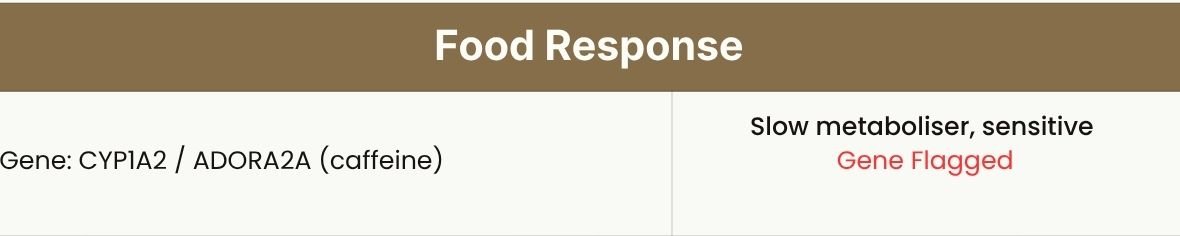
The most actionable finding in this section is caffeine: this person both clears caffeine slowly and is more sensitive to its effects. That combination means caffeine lingers longer and hits harder than for most people — which can quietly explain disrupted sleep, anxiety-like symptoms, or an afternoon energy crash that's blamed on other things.
This suggests: a closer look at total caffeine intake and timing as part of the wider plan. This is something that's easy to overlook when fatigue or poor sleep are being investigated from a purely nutritional angle.
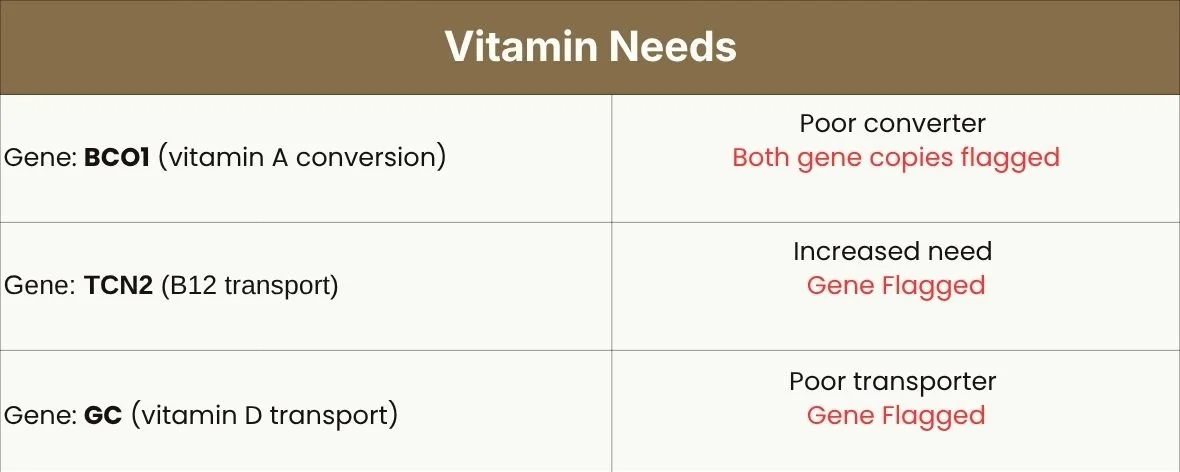
This person's genes show a reduced ability to convert plant-based beta-carotene into usable vitamin A. This means: a diet built around carrots and spinach for vitamin A may simply not deliver as much as it would for someone else, regardless of how "healthy" it looks on paper.
The B12 transport gene flags an increased need, not because dietary B12 is necessarily low, but because this person's body is less efficient at getting it into cells once absorbed.
This suggests: prioritising specific food forms (preformed vitamin A from animal sources rather than relying on beta-carotene; active B12 forms) and being aware that standard vitamin D doses may need to run higher than generic guidelines suggest.
None of this replaces testing actual blood levels where relevant, it simply explains the "why" behind them.
The vitamin D transport finding is one of the most common and useful flags on this report: it means circulating vitamin D may run lower than expected even with reasonable sun exposure or supplementation, which matters for anyone whose vitamin D levels have been stubbornly low despite "doing everything right."
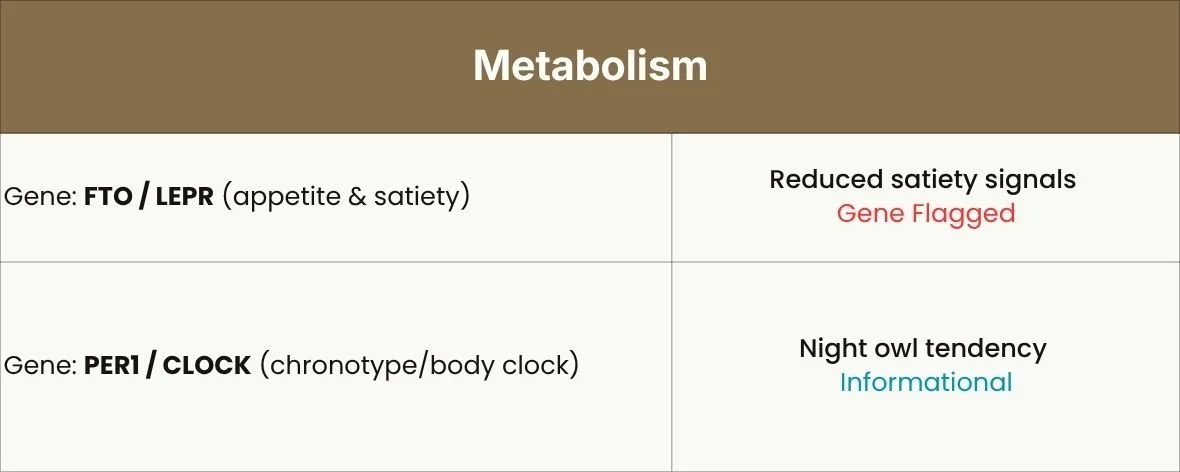
Two separate genes here both point toward reduced satiety signalling — meaning this person's biology makes it genuinely harder to feel full and easier to overeat, particularly on energy-dense foods. That's a meaningful thing to know about yourself; it reframes "I have no willpower" as "my biology gives me a weaker stop signal," which calls for a different strategy (protein, fibre and meal structure) rather than more self-discipline.
The chronotype genes are simply descriptive: this person is wired to be a night owl, which isn't a problem to fix, just useful to know when planning routines, workouts or even when to schedule focused work.
This suggests: meal structure and food choices that account for a weaker natural satiety signal , plus working with rather than against a later natural rhythm where lifestyle allows.
None of these findings are diagnoses, and none of them are destiny.
What they offer is a layer of context that explains why certain things might be harder for one person than another, even when they're doing everything "right."
A vitamin D level that won't budge,
a vague sense that willpower around food isn't the problem,
caffeine that hits differently
These are the kinds of patterns that genetics can help explain when diet and lifestyle changes alone haven't been enough.
A scientist's perspective
Genetics is the area where I'm most careful about managing expectations. A genetic variant describes a tendency, not a certainty. Lifestyle, diet and environment usually have far more influence over how a gene actually expresses itself than the gene alone.
I'm a qualified Lifecode Gx practitioner specifically because I wanted formal training in reading these reports properly, rather than treating them as a checklist.
In practice, I use nutrigenomic results as one layer of context that refines a plan. For example, favouring a specific form of a vitamin, or paying closer attention to caffeine timing, rather than something that drives the whole plan on its own.
It's a one-off test, so it tends to work well alongside a programme rather than as a starting point by itself.
Curious what your genes might explain?
Nutrigenomic testing works well alongside any programme. Start with a free discovery call to talk through whether the Nutrient Core or a more specific Lifecode Gx report is the right fit for you.